


The 10 Most Iconic Landmarks on the Las Vegas Strip, From the Welcome Sign to the Sphere

If you want to understand the Strip through its skyline, start with ten structures that show how Las Vegas has reinvented itself: a 1959 roadside sign, theatrical resorts from the 1990s, large-scale public attractions, and a programmable sphere built for digital media.
I’m treating “most iconic” as an editorial selection, not a measurable ranking. These iconic Las Vegas Strip landmarks made the list because they are instantly recognizable, represent an important design era, and contribute something more than a hotel name or conventional marquee. For residents and home shoppers, they also provide a useful lesson: the postcard view is only one part of living near the resort corridor.
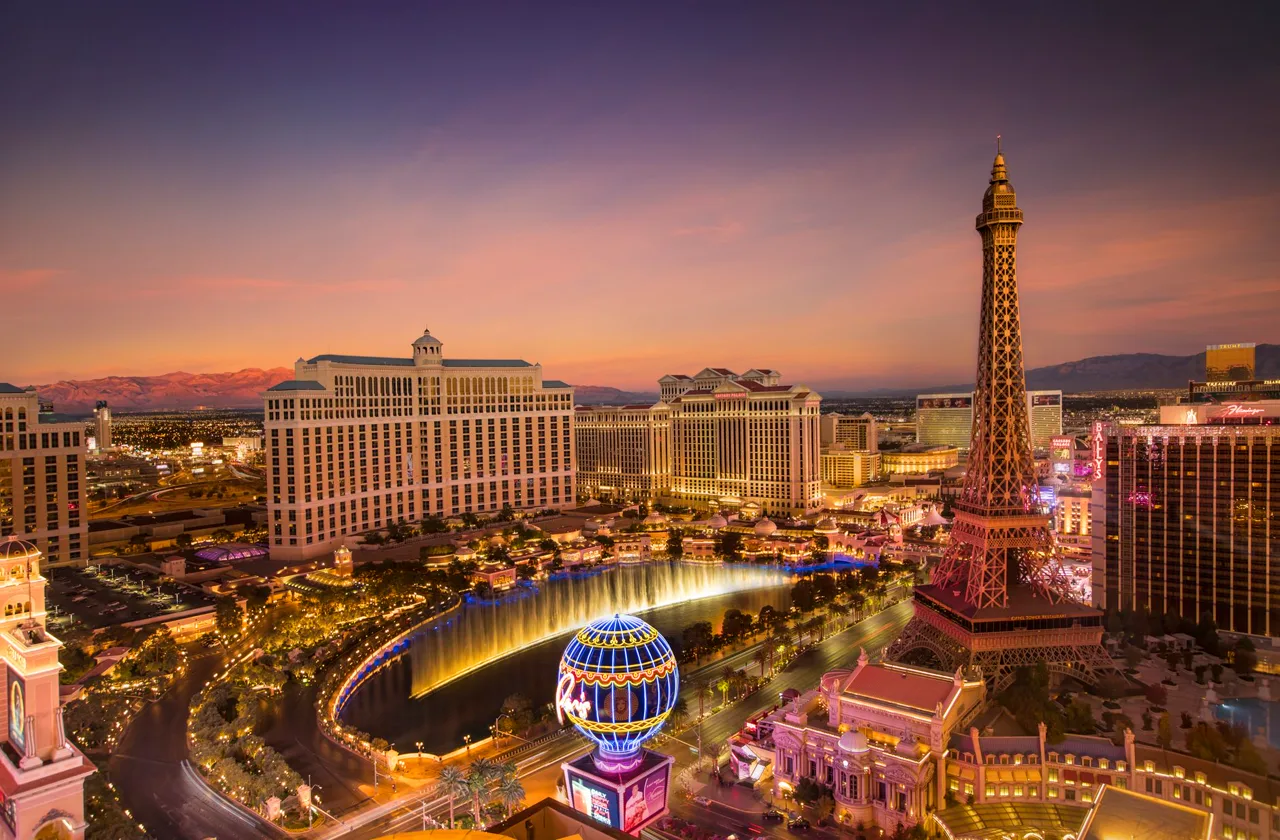
The Strip is mostly outside Las Vegas city limits
Here is the geographic detail that catches many people off guard: most of the recognized Strip is not within the City of Las Vegas. It lies in unincorporated Clark County, even when a property uses “Las Vegas” as its mailing address. As explained in Clark County’s overview of local government, the county handles functions such as planning, building inspection, roads, and fire protection in unincorporated areas.
The High Roller and Sphere sit east of Las Vegas Boulevard, but they are conventionally part of the broader Strip resort corridor. The STRAT is another major skyline marker, though it stands north of the traditional Clark County Strip boundary. That is one reason any list of ten will leave out a credible alternative.
The landmarks operate within a visitor economy of enormous scale. According to the Las Vegas Convention and Visitors Authority, Las Vegas welcomed 38.5 million visitors in 2025, a 7.5% decline from 2024, while convention attendance remained near 6 million. Continued investment in distinctive buildings and attractions is therefore more than decoration; it is part of how the destination competes for attention.
What makes a Strip landmark iconic?
Architects Robert Venturi, Denise Scott Brown, and Steven Izenour famously argued in Learning from Las Vegas that commercial signs and symbolic buildings deserved serious study. Strip architecture has to communicate across broad roads, large setbacks, and moving traffic. A simple silhouette can be more effective than a subtle façade.
UNLV architecture professor Glenn Nowak has added an important local perspective: themed properties should be judged in the period when they were created, and some design teams studied historic architecture abroad rather than treating the theme as a superficial costume. That helps explain why several 1990s resorts still read clearly even beside newer glass towers and digital displays.
| Landmark | Signature visual | What it represents |
|---|---|---|
| Welcome sign | Midcentury roadside sign | Las Vegas identity before the megaresort era |
| Luxor | Black pyramid and Sky Beam | A building that functions as its own sign |
| Excalibur | Colorful castle towers | The theatrical resort boom |
| New York-New York | Layered skyline, statue, and bridge | Landmark design at both skyline and pedestrian scale |
| Bellagio fountains | Choreographed water | A free attraction integrated with the boulevard |
| Paris Eiffel Tower | Half-scale steel tower | A replica that shapes an entire visual district |
| Caesars Palace | Roman fountains, columns, and statuary | Long-running themed architecture adapted over time |
| The Venetian | Campanile, Rialto Bridge, and canals | Theme used for circulation and retail theater |
| High Roller | Enclosed observation wheel | An attraction anchoring an open-air promenade |
| Sphere | Programmable exterior display | Architecture functioning as digital media |
The 10 defining landmarks
1. Welcome to Fabulous Las Vegas sign
According to Clark County’s history of the Welcome sign, designer Betty Willis created it in 1959. The 25-foot-tall Googie-style sign stands at 5100 Las Vegas Boulevard South and has been listed on the National Register of Historic Places since 2009. Its reverse carries the send-off, “Drive Carefully, Come Back Soon.”
Its meaning now reaches beyond tourism. Following the October 1, 2017, mass shooting, the location became a spontaneous community memorial. That moment showed how a commercial roadside symbol had also become a civic gathering place.
The sign sits in a roadway median with designated visitor parking. Use the provided access area and marked pedestrian routes rather than treating Las Vegas Boulevard as an informal crossing.
2. Luxor pyramid and Sky Beam
MGM Resorts’ 2026 property fact sheet dates Luxor’s opening to October 13, 1993. Its black-glass pyramid rises approximately 350 feet over 30 stories, while two 22-story towers were added later. The pyramid is identifiable without a conventional sign, which is exactly what makes the architecture so effective.
The Sky Beam strengthens that identity after dark. I would skip popular claims that it is the “brightest light on Earth” or can be seen from a precise distance of hundreds of miles; the resort’s published material does not provide the technical operating and atmospheric data needed to support those statements.
3. Excalibur’s castle frontage
According to MGM Resorts, Excalibur opened on June 19, 1990. Its cluster of colorful medieval towers created an unmistakable marker at the Tropicana Avenue intersection, especially when viewed beside Luxor’s much simpler geometric form.
The castle is not merely a decorative layer attached to a generic tower. Its silhouette organizes the property’s entire visual identity. Newer resorts may rely on glass and digital displays, but Excalibur remains easy to recognize from a moving vehicle because its shape is bold and uncomplicated.
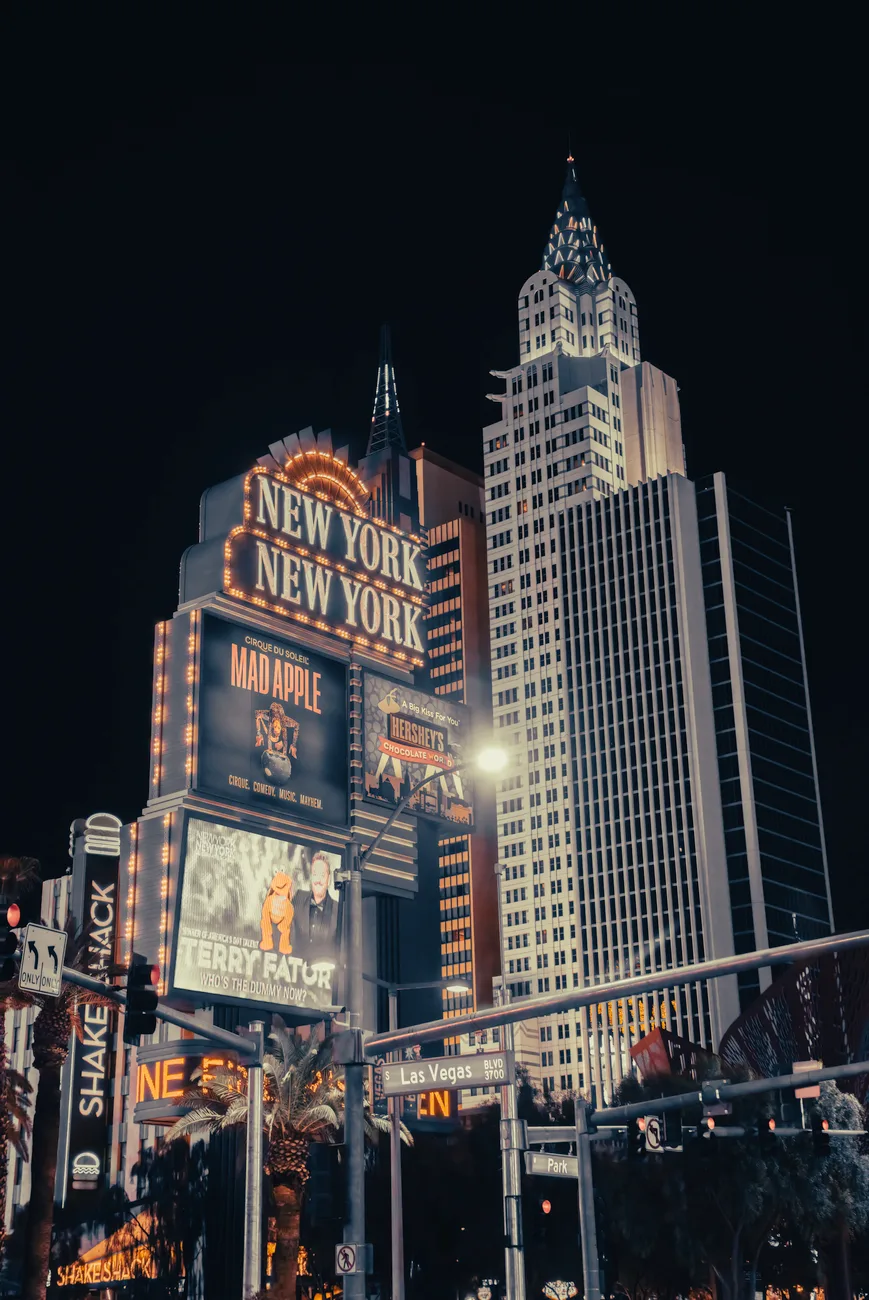
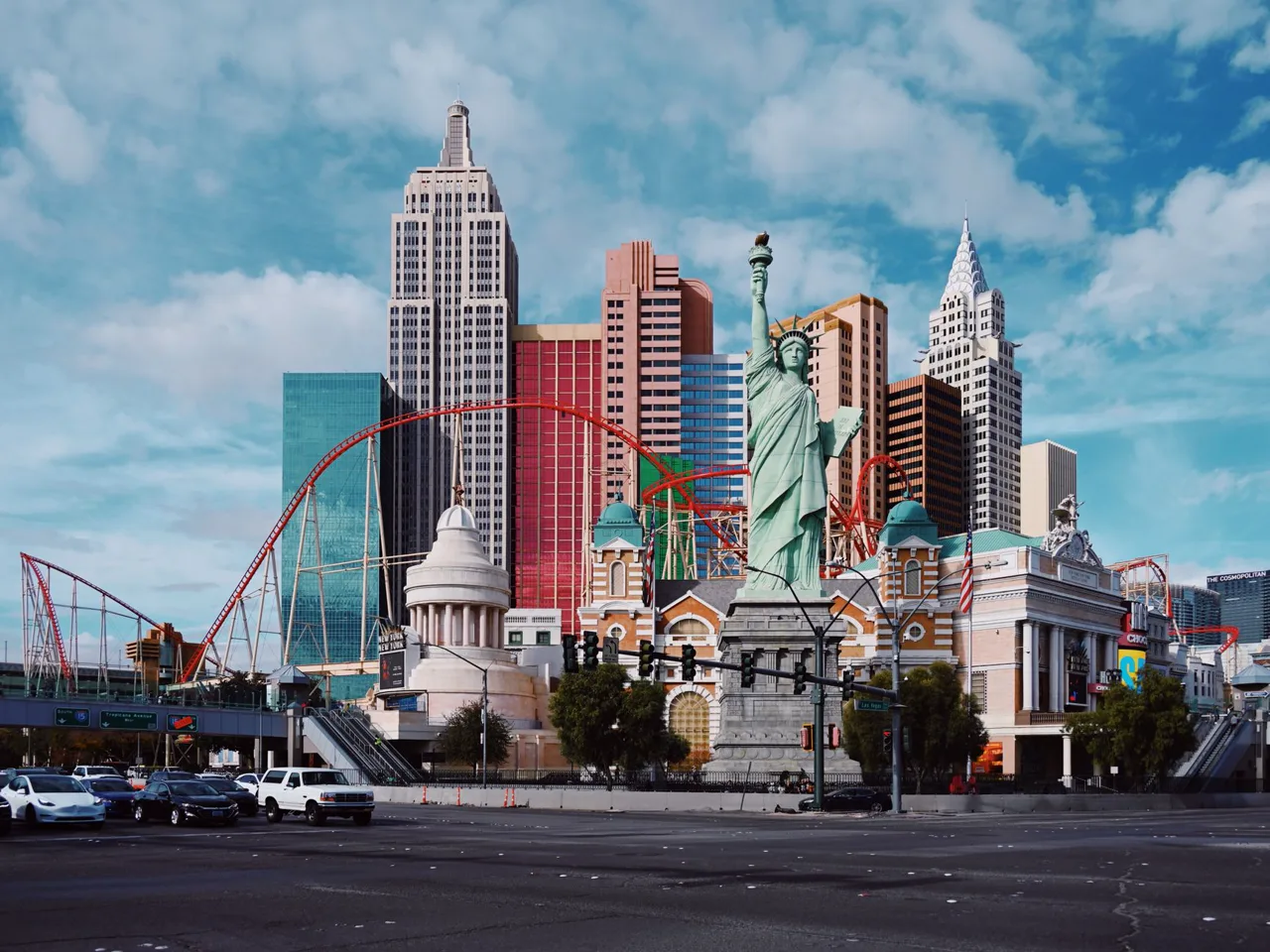
4. New York-New York skyline and Statue of Liberty
MGM Resorts’ official fact sheet says New York-New York opened January 3, 1997. The property combines 12 towers modeled after Manhattan buildings, a 150-foot Statue of Liberty replica, and a 300-foot Brooklyn Bridge replica. The hotel towers are approximately one-third the scale of their New York inspirations.
What makes the design work is its layering. The skyline reads from a distance, while the bridge and street-level façades give pedestrians a closer visual experience. Calling it a “miniature New York” misses how deliberately those different scales work together.
5. Fountains of Bellagio
Bellagio opened in 1998 with a fountain system containing more than 1,200 dancing fountains across a lake larger than 8.5 acres, according to MGM Resorts’ published information. Water can reach as high as 460 feet across a span exceeding 1,000 feet. The size matters, but choreography and the open view from Las Vegas Boulevard are what turned the fountains into a lasting public attraction.
Shows are free and generally run every 15 or 30 minutes depending on the day and time. Because schedules can change for weather, maintenance, or special events, check the official Fountains of Bellagio schedule before building an evening around one performance.
Bellagio should no longer be described without qualification as the world’s largest choreographed fountain system. Larger systems have opened elsewhere. Its stronger claim is longevity and the way it interacts with the surrounding streetscape.
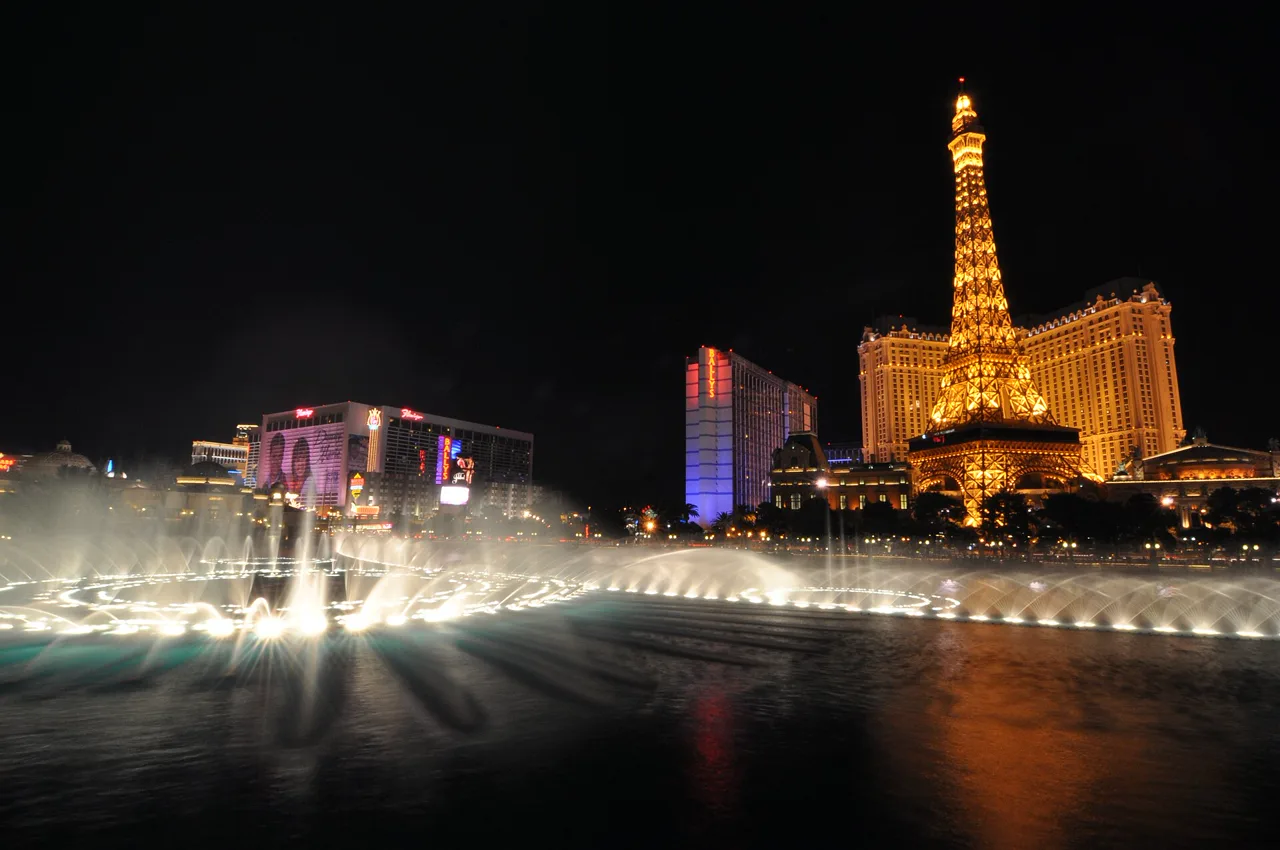
6. Eiffel Tower at Paris Las Vegas
Caesars Entertainment’s property fact sheet dates the Eiffel Tower’s opening to September 1, 1999. The 541-foot structure is a half-scale replica built with approximately 5,000 tons of welded steel. Caesars identifies it as the tallest reproduction of the Paris original.
A $1.7 million lighting system introduced in 2019 added roughly 300 color-washing fixtures and more than 800 strobes. Yet the tower’s visual value is relational as much as structural: some of its most recognizable views place it across the boulevard from Bellagio’s lake and fountains.

7. Caesars Palace frontage and fountains
Caesars Palace opened on August 5, 1966, making it one of the longstanding names represented among these ten selections. Its Roman statues, columns, fountains, and ceremonial entrance helped establish the idea of a fully themed resort decades before the building boom of the 1990s.
The property also shows that an icon does not have to remain unchanged. A recent entrance renovation raised the ceiling, refreshed the casino dome, and installed a 15-foot Carrara-marble Augustus Caesar beneath a chandelier containing 70,000 crystals, according to Caesars Entertainment’s 2024 fact sheet. The theme has endured partly because it keeps being adapted.
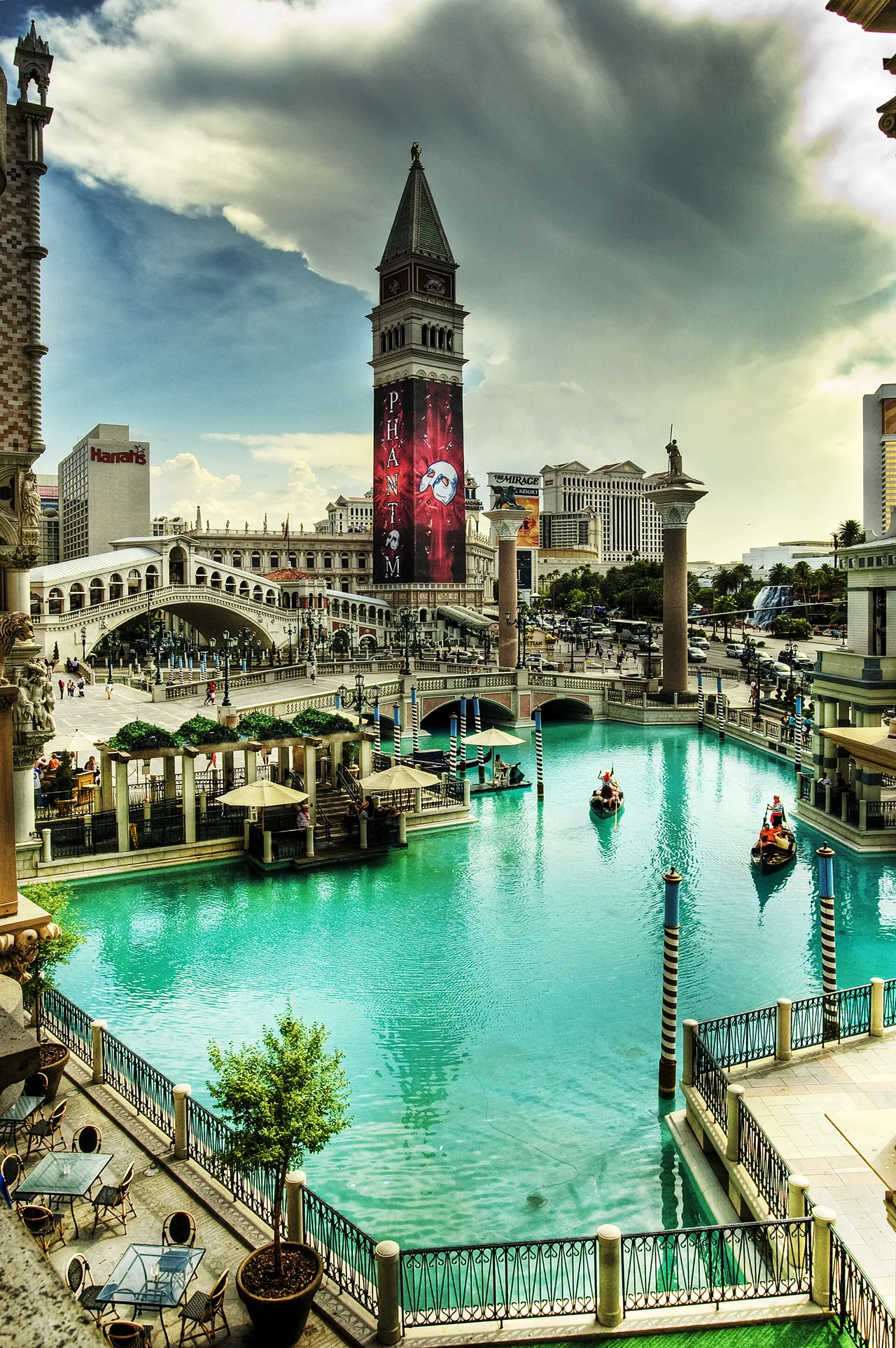
8. The Venetian’s Campanile, Rialto Bridge, and canals
The Venetian opened in 1999 with interpretations of St. Mark’s Campanile, the Doge’s Palace, and the Rialto Bridge, along with indoor and outdoor canals. Those canals are not just scenery. They direct movement through the property, frame retail spaces, and operate as a paid attraction.
The resort announced a $1.5 billion reinvestment program during its 25th anniversary in 2024. Plans included redesigning approximately 4,000 Venetian suites along with convention, dining, and brand upgrades. The announcement illustrates how themed architecture can remain commercially useful when the surrounding property continues to evolve.

9. High Roller observation wheel
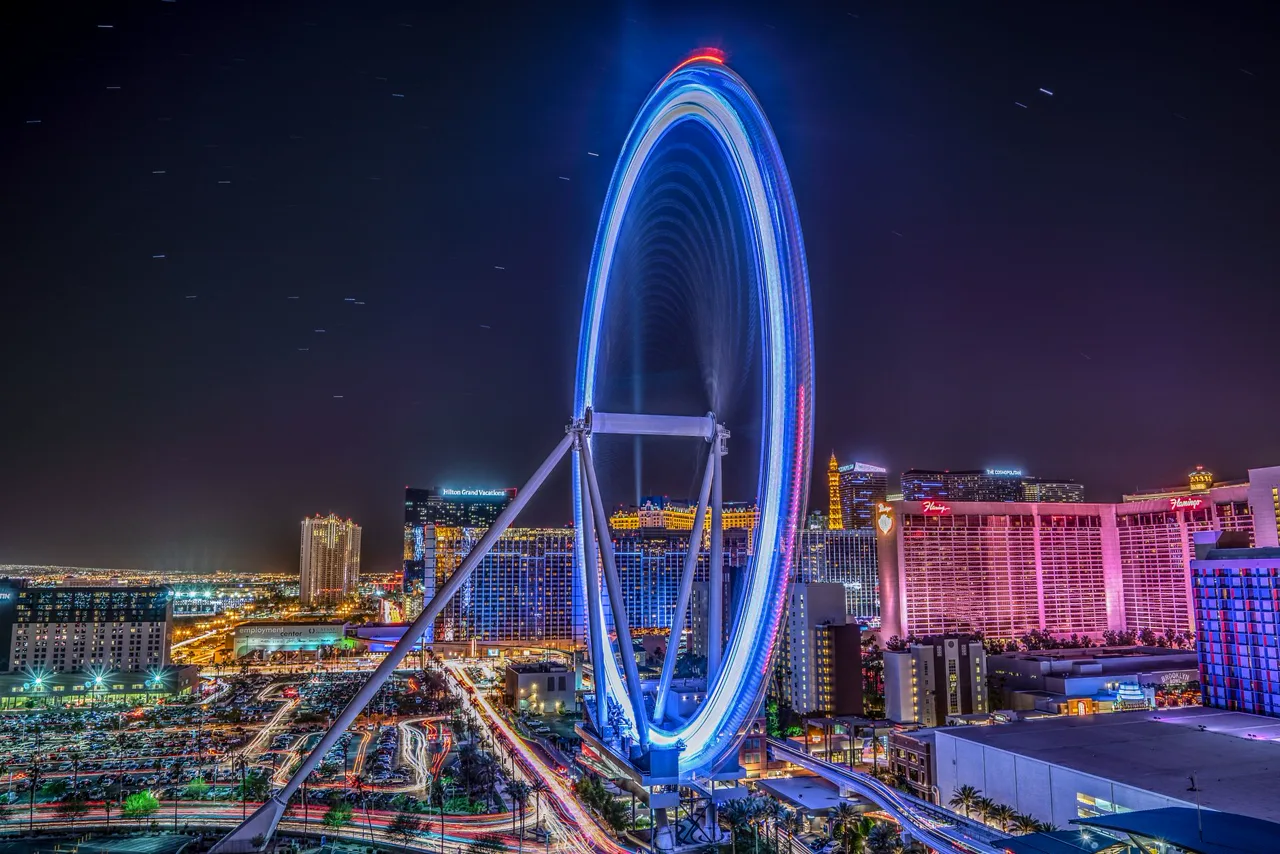
According to Caesars Entertainment’s 2023 fact sheet, the High Roller is 550 feet tall and contains 28 enclosed cabins. One rotation takes approximately 30 minutes. Older descriptions sometimes call it the tallest observation wheel in the world, but Caesars now accurately markets it as the tallest observation wheel in North America.
The wheel also represents a change in development strategy. Instead of placing every attraction inside a self-contained casino, it anchors an open-air promenade that pulls pedestrian activity east from Las Vegas Boulevard.
10. Sphere
Sphere opened with a U2 performance on September 29, 2023. The structure is 366 feet tall and 516 feet wide, while its programmable exterior is known as the Exosphere. Sphere’s technical materials identify approximately 580,000 square feet of exterior LEDs and a 160,000-square-foot interior display.
As of August 2023, Sphere Entertainment estimated Sphere’s final construction costs at approximately $2.3 billion, inclusive of core technology and soft costs but excluding significant costs such as content creation, internal labor, capitalized interest, and furniture and equipment, according to the company’s public SEC filing. Unlike the replicas that defined much of the 1990s Strip, Sphere is an original building-media platform. Its architecture, advertising surface, and entertainment technology cannot be separated from one another.
Seeing the landmarks without letting the map fool you
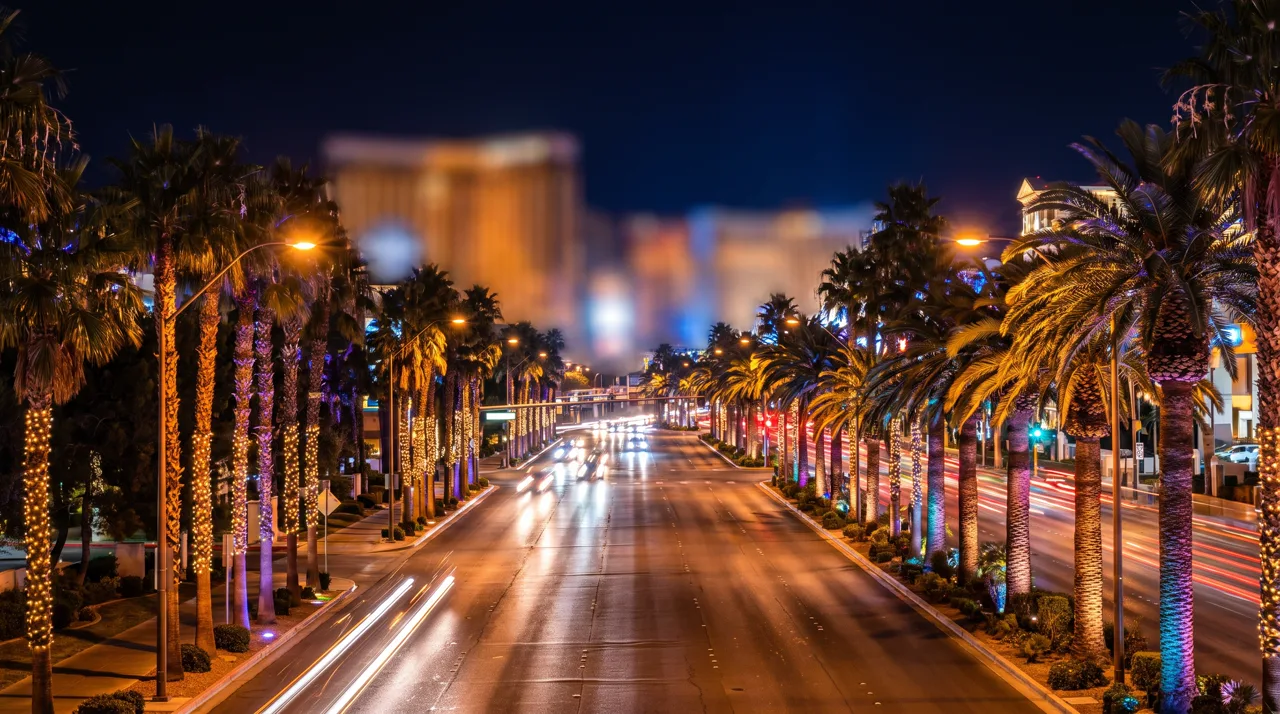
Distance and walking time are not interchangeable on the Strip. Resort footprints are large, direct street crossings are limited, and the route that looks shortest on a map may lead through an elevated bridge or resort interior. Daytime heat can also turn an ambitious walking plan into an uncomfortable one.
Clark County’s resort-corridor bridge information explains how elevators and escalators help separate large pedestrian volumes from vehicle traffic. The system improves traffic separation, but it also means a landmark directly across the boulevard may require a longer route than its visual distance suggests.
Local reality: “Across the street” on the Strip is a visual description, not a reliable walking-time estimate. Follow designated bridges and crossings even when the direct route appears shorter.
If you want to see all ten, it is more practical to think in clusters than as one continuous stroll:
- Welcome sign: Treat it as a dedicated stop because of its median location and designated access.
- South Strip: Group Luxor, Excalibur, and New York-New York.
- Central Strip: Pair Bellagio, Paris Las Vegas, and Caesars Palace.
- East and north-central corridor: Plan the High Roller, The Venetian, and Sphere around their actual pedestrian routes rather than straight-line distance.
Check current attraction schedules and road notices shortly before you go. Event construction, temporary closures, and transportation changes can affect an otherwise familiar route.
What the landmarks mean for nearby real estate
A view is a current feature, not a permanent right
As a Broker/Salesperson in the Las Vegas Valley, I treat a landmark view as a property characteristic-not a guarantee that the same view will exist indefinitely. Unless a recorded legal instrument protects it, a view can be altered by new construction, redevelopment, landscaping, signs, or changes on another parcel.
There is also no defensible public percentage for the sale-price premium attributable to a view of one specific Strip landmark. Floor level, orientation, window placement, condition, building amenities, and competing inventory all affect what a buyer may pay. A generic “Strip-view premium” applied without comparable sales is not a sound valuation method.
Recent redevelopment makes the risk easy to see. The Mirage closed on July 17, 2024, for conversion into Hard Rock Las Vegas, whose announced plans include a nearly 700-foot guitar-shaped hotel. On October 9, 2024, the Tropicana implosion removed two 22-story towers, clearing the site for a planned Athletics ballpark, according to Major League Baseball’s account of the demolition. Both sites are reminders that an open view or familiar skyline reference can change.
Proximity includes event operations
Being close to the Strip can provide visual access and shorter trips to entertainment, but it can also expose a property to event traffic, detours, lighting, and sound. Those conditions vary by building orientation and time, so a daytime tour alone does not show the full experience.
During the 2025 Las Vegas Grand Prix, Clark County documented Koval Lane closures, transit detours, and closure of the Bellagio bus stop. Even if you do not live directly on the course, special-event operations can change how you cross or approach the resort corridor.
Brightness and sound should be evaluated separately. A 2024 Clark County planning report found no code-enforcement violations related to Exosphere signage or brightness, while a separate public discussion concerned outdoor audio. A regulatory finding about one issue does not tell you how a particular unit will look or sound after dark.
A practical due-diligence checklist
- Confirm the governing jurisdiction. Determine whether the property falls under Clark County or a city before researching zoning, code enforcement, and planned projects.
- Visit at more than one time. See the property during daylight and after dark, when resort lighting and entertainment activity are operating.
- Test the actual route. Drive, walk, or use transit at the hours when you expect to travel rather than relying only on mileage.
- Review recorded documents. If a protected view is central to your decision, have the title documents and any claimed easement reviewed by a qualified title professional or real estate attorney.
- Use comparable sales carefully. Compare units with similar height, orientation, condition, and view quality instead of applying a universal landmark premium.
- Check scheduled events and proposed development. A normal weekday visit may not reveal the traffic pattern during a major race, convention, concert, or construction phase.
The best decision rule is simple: enjoy a Strip landmark as a current amenity, but do not treat it as a permanent promise. Confirm the real route, experience the setting after dark, and require recorded protection before paying specifically for a supposedly guaranteed view. The Strip’s constant reinvention is what makes its landmarks compelling-and what makes careful due diligence necessary.

Other Articles
DIY Home Decor Projects for Mindful Living Spaces
